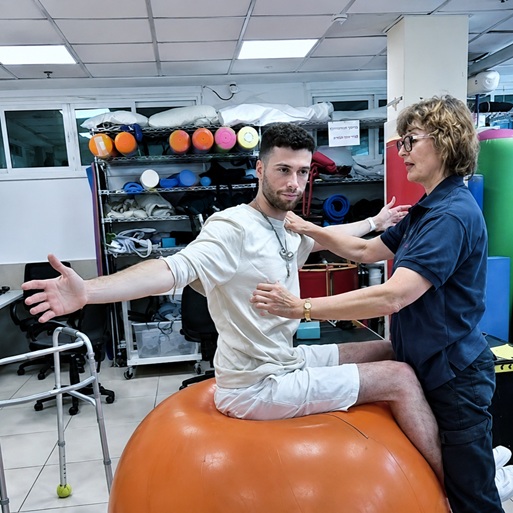

Eran Blaish, 27, flew to Budapest for a vacation and began experiencing back pain that initially seemed to him like just another routine case of a stiff back. Within a few weeks, his functional condition deteriorated to the point that he was unable to stand on his feet. Tests revealed that Eran had contracted Brucella bacteria from drinking or eating an unpasteurized dairy product.
“I don’t know exactly what I ate or what I was exposed to that caused this,” recalls Eran, who has been hospitalized for a week and a half at Reuth Rehabilitation Hospital in Tel Aviv.
“When I returned from the trip, I started having a cough and night sweats. They thought I had caught a viral illness, but the pain in the sacrum area of my pelvis kept getting worse until I could no longer stand, get up from the couch at home, or walk. My legs were shaking intensely, and I also stopped working.”
After two visits to the emergency department, the diagnosis was made through culture tests. “I eat cheese from time to time and I’m not looking for adventures when it comes to nutrition. When I received the diagnosis, I was shocked and very stressed.
I arrived at rehabilitation confined to a wheelchair, and fortunately there is a very good and professional team here that supports me. I have also made friends my age in the department, and that greatly improves my mood. I can see improvement day by day; I am already getting around with a walker and am more independent. There are rehabilitation patients here who have gone through more difficult things than I have and are coping with their situation very well, and that is very uplifting for me.”
Dr. Diana Goldin, Director of the Rehabilitation Department, emphasized that this is a rare case. “The bacterium may affect several systems, including the nervous system and the musculoskeletal system, and it may cause inflammation in the joints, spinal vertebrae, and pelvis. The incubation period ranges from several days to several months. In Eran’s case, the damage is manifested in the bones and joints of the pelvis. We are working with him on load-bearing, improving mobility, stability, and weight-bearing capacity. He is a young, healthy man with high motivation, so we anticipate significant improvement in the coming weeks.”